
 Walt
Walt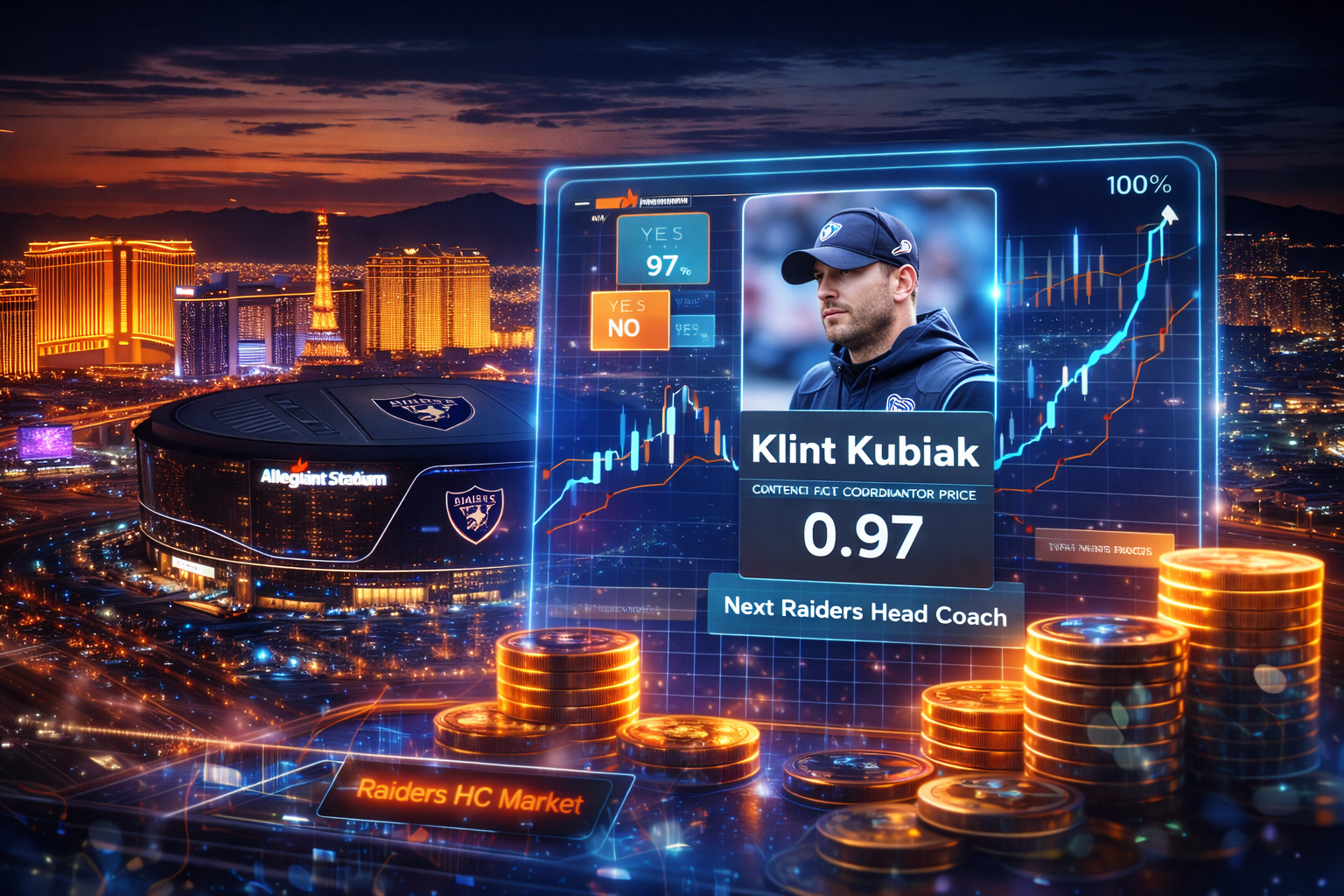
With prediction markets pricing Klint Kubiak as an overwhelming favorite, the Raiders’ coaching search is no longer just about who is next. It is about what kind of reset Las Vegas is committing to and why the market sees this outcome as almost inevitable.
The Las Vegas Raiders enter Super Bowl weekend at a crossroads that has felt familiar for far too long. A 3–14 season forced another reset and handed the franchise the No. 1 overall pick in the 2026 NFL Draft. Ownership and the front office have talked about stability before, but this time, the timeline and the roster suggest something deeper is happening.
As of Friday, February 6, prediction markets have effectively converged on one outcome. Seattle Seahawks offensive coordinator Klint Kubiak is being priced as the next permanent head coach in Las Vegas, with little room left for uncertainty. That pricing matters because it reflects aggregated belief rather than a single report, and it gives you a window into how informed observers expect this search to end.
Other candidates have appeared in the market at various stages of the hiring cycle, though none have sustained meaningful probability. Defensive coordinators, former head coaches, and college program leaders have all briefly registered price movement, but liquidity has consistently flowed back toward Kubiak.
This matters because prediction markets price relative probability, not just individual likelihood. A candidate sitting at 97 percent is not only seen as likely — he is viewed as overwhelmingly more plausible than every alternative combined.
Kalshi pricing leaves little room for doubt
Kalshi operates differently from a sportsbook. Instead of odds, you buy Yes or No contracts tied to real-world outcomes. A contract priced at 97 cents implies a roughly 97 percent probability once fees and liquidity are considered. In the Raiders’ next head coach market, Klint Kubiak has sat at that level for days.
Liquidity adds another layer to how these signals should be read. In thin markets, a single large trade can distort probability. In active markets, sustained pricing reflects broader conviction across participants.
The Raiders coaching market has shown steady order flow rather than sporadic spikes. That consistency suggests traders are reacting to accumulated reporting and insider-aligned expectations rather than speculative swings.
That does not mean the outcome is official. It does mean the market believes the remaining risk is procedural, not philosophical. Reporting has consistently indicated that the Raiders are waiting until after the Super Bowl because Kubiak is still coaching. The market is simply pricing in that reality. If you want to see how these markets function from the user side — including contract eligibility, settlement rules, and how positions are entered and exited — platform onboarding explainers provide useful context. Materials available through the Kalshi bonus page walk through how Yes and No contracts operate in live markets and why pricing behaves the way it does in situations like this one.
Once you understand the mechanics, the signal becomes clearer. The market is not guessing; it is responding to alignment between reporting, roster logic and how decision-makers inside the building appear to be thinking.
Prediction markets have historically performed well in forecasting front-office decisions, particularly when contract eligibility is tightly defined. Coaching hires, draft positioning, and executive appointments often converge toward the eventual outcome days or weeks before official announcements.
While markets are not infallible, late-cycle pricing above 90 percent has tended to resolve in line with the favored outcome, barring unexpected ownership intervention or contractual breakdowns.
The coach this reset calls for
Las Vegas is not hiring a head coach in a vacuum. The roster context is significant, and it explains why an offensive architect is being favored so heavily.
Kubiak’s candidacy is rooted not only in scheme fit but in lineage and developmental track record. The son of Super Bowl-winning head coach Gary Kubiak, he has worked across multiple offensive systems, including stints in Minnesota, Denver, New Orleans, and Seattle.
His offenses have typically leaned on zone-run frameworks, layered play-action concepts, and quarterback-friendly progression structures. That background positions him as a system builder rather than a personality hire — a distinction that matters for a franchise entering a full rebuild.
The Raiders averaged just 14.2 points per game in 2025. They ranked near the bottom of the league in total offense at 245.2 yards per game. The running game produced only 77.5 yards per game, and the offensive line allowed pressure at a rate that left quarterbacks constantly exposed.
Those numbers make one thing clear. This is not a job where the next coach can simply lean on culture and defensive identity while waiting for incremental improvement. The Raiders need structure. They need a system that can support a young quarterback and create offense without relying on perfect conditions.
That context shows up clearly when you look at the Raiders’ 2026 team needs, which outline the scope of the reset across quarterback, offensive line and skill positions. This is a multi-year build, not a quick fix, and the head coach's choice has to match that reality.
Decision-making structure also shapes how this hire unfolds. Raiders owner Mark Davis retains final authority, but minority ownership involvement — including Tom Brady’s advisory presence — has introduced additional evaluative input into football operations.
That dynamic does not dilute Davis’s control, but it broadens the informational lens through which coaching candidates are assessed, particularly on offensive philosophy and quarterback development alignment.
Everything flows from the quarterback
The No. 1 overall pick changes the coaching calculus entirely. Whoever takes this job is not just leading the Raiders. He is shaping the environment for a rookie quarterback who will be asked to carry the franchise almost immediately.
Early projections already frame that decision. In the latest 2026 NFL Mock Draft, Las Vegas is consistently linked to a quarterback at the top of the board. Whether that projection holds or shifts over the coming months, the underlying truth remains the same. The next head coach must be able to build an offense that lowers the burden on a young passer rather than amplifying it.
This is where Kubiak’s profile aligns with the moment. His offenses in New Orleans and Seattle emphasized timing, play-action and defined reads. They did not ask the quarterback to be perfect. They asked him to be decisive.
What Tom Brady’s broadcasts revealed about Kubiak’s offense
One of the most unusual elements of this coaching cycle has played out in plain sight. During Seattle’s playoff run, Fox’s lead broadcast team called two Seahawks games. That meant Tom Brady, who is also a minority owner of the Raiders, spent multiple postseason games analyzing Kubiak’s offense in real time.
What stood out was not a single play call. It was the pattern. Brady repeatedly highlighted tempo early in games, personnel flexibility and the way the run game set up everything else. He pointed to outside zone concepts that consistently gained modest yardage but forced defenses to overcommit. From there came play-action screens and intermediate throws that kept the offense on schedule.
Brady also focused on how Kubiak moved his primary weapons around the formation. By aligning receivers in the slot, out wide and even in the backfield, the offense removed predictability. Defenses could not simply key on one matchup. That kind of flexibility matters when you are trying to simplify reads for a quarterback.
Late in tight games, Brady noted Kubiak’s willingness to stay aggressive rather than defaulting to conservative calls. Those moments spoke to trust in the system and confidence in preparation, which are traits teams look for when projecting a coordinator into a head coaching role.
Early signs of a new direction
League hiring protocols also influence the timing. Teams must complete Rooney Rule interview requirements before finalizing head coaching appointments, and coordinators coaching in the Super Bowl cannot formally sign contracts until their postseason obligations conclude.
These procedural checkpoints often create short windows where outcomes are widely expected but not yet official — the exact gap that prediction markets attempt to price.
If the hire proceeds as the market expects, it will be known that the interviews have concluded, the immediate challenge will not be winning the AFC West overnight. It will be building a baseline.
Expect an offense that prioritizes sequencing over volume. Expect heavy use of play-action even when the run game is not dominant. Expect defined roles for skill players rather than static alignments. Most of all, expect a system designed to give a young quarterback answers before the snap rather than asking him to improvise constantly.
Even heavily favored markets retain residual risk. Contract negotiations, staffing disagreements, or ownership pivots can still disrupt late-stage hiring processes. External candidates occasionally re-enter consideration if negotiations stall, particularly when draft timelines compress decision windows.
These tail risks explain why prediction contracts are rarely priced at a full 100 percent prior to formal announcement.
There will still be questions. Head coaching requires managing an entire organization, not just an offense. Staff selection, game management and locker room authority all matter. But the reason the market has moved so aggressively in one direction is that the Raiders’ needs and Kubiak’s strengths overlap in a way that is difficult to ignore.
 Charlie Campbell