 Walt
Walt
Have you ever watched a college quarterback light up the stat sheet for three straight seasons and then wondered why scouts still can't agree on his NFL ceiling? It happens more often than you'd think. The evaluation process for quarterbacks remains one of the most debated topics in football circles – and the upcoming draft class is about to make those conversations even more interesting.
We're entering a period where the old metrics feel increasingly inadequate. Completion percentage tells you something, sure. Touchdown-to-interception ratio matters, obviously. However, the game has progressed to the point where professional success cannot be predicted by these figures alone. This article will explain what makes this specific quarterback class intriguing, why evaluation techniques are changing, and what trends in college football are making their way into the professional ranks. Just as analytics have transformed how fans follow a free slots tournament —where numbers, patterns, and player behavior shape strategy—modern quarterback scouting is evolving beyond basic stats. Consider this your gateway to understanding the next generation of signal-callers – not a prediction of who'll succeed, but a framework for watching more intelligently.
Another thing worth noting upfront: we're dealing with projection, not certainty. College success does not guarantee NFL success, and the history of quarterback busts serves as a reminder that even the most astute evaluators often make mistakes. Here's our attempt to make sense of what we're seeing.
The usual start: what makes this quarterback class different
Every draft cycle brings claims about "generational talent" and "the deepest class in years." Most of those claims age poorly. But the 2026 group genuinely presents something unusual – a collection of quarterbacks who've operated in NFL-style systems at the college level to a degree we haven't seen before. The spread of pro-style concepts through college football accelerated dramatically over the past five years. Coordinators who cut their teeth in the NFL are now running college offenses, and their quarterbacks are learning progressions, protections, and terminology that used to require a year or two of professional adjustment.
What this means practically: the physical tools still matter enormously, but the mental component arrives more developed than previous generations. Quarterbacks entering the league understand concepts like "MIKE" identification, protection slides, and hot routes in ways that 2015-era prospects simply didn't.
The flip side – and there's always a flip side – is that defenses have also gotten more sophisticated. The NFL isn't standing still waiting for these quarterbacks to arrive. Disguised coverages, simulated pressures, and post-snap rotations are more complex than ever. A quarterback who read college defenses effectively still faces a significant learning curve.
Mechanics inform your evaluation process
While the organizational buzz around quarterback prospects follows similar patterns each year, the actual evaluation criteria vary significantly. Some emphasize arm strength above all else. Others prioritize accuracy. You'll find scouts who care most about pocket presence and others who value mobility.
However, mechanics remain the biggest differentiator in long-term success. They dictate more than just how throws look – they determine consistency under pressure, accuracy at different levels, and durability over a sixteen-game-plus season. The only way to truly evaluate mechanics is through systematic film study, and that requires effort most casual fans aren't willing to invest.
We've prepared a breakdown of mechanical elements that matter most, paired with what to watch for in college tape. Once again, you need to understand that projection involves uncertainty. These observations aren't guarantees, just methods of positioning your evaluation more thoughtfully.
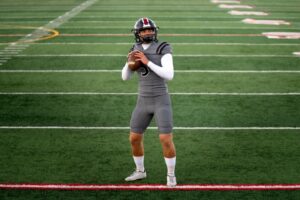
- Footwork fundamentals are among the most predictive elements, especially for quarterbacks transitioning from spread systems. The ability to reset feet in a condensed pocket separates NFL starters from career backups more reliably than almost any other physical trait. Watch how a quarterback handles interior pressure specifically – does he climb the pocket with balanced feet, or does he bail laterally at the first sign of trouble? The former projects better regardless of arm talent.
- Release timing matters because NFL windows close faster than college windows. A quarterback with a long windup who succeeded against Big Ten defenses may struggle when cornerbacks close that extra half-second quicker. The good news: release can be coached to some extent. The bad news: ingrained habits from four years of college are difficult to break.
- Platform stability refers to how consistent a quarterback's base remains through his throwing motion. The best quarterbacks maintain the same platform whether throwing from a clean pocket or on the move. Variance here leads to accuracy inconsistencies that become glaring at the professional level. Watch for quarterbacks whose footwork falls apart under pressure versus those who maintain their base even when things get chaotic around them.
The college football trends filtering upward
The relationship between college and professional football has never been more interconnected. Plays that originated in the NFL appear on college fields within weeks. Concepts that prove successful at the college level get adopted by professional coordinators within a season. This feedback loop affects quarterback development in ways both obvious and subtle. The RPO revolution – run-pass options where the quarterback makes post-snap decisions based on defender reactions – transformed college offenses over the past decade. NFL teams adopted these concepts but with significant modifications. College quarterbacks who've lived in RPO-heavy systems face an adjustment period learning to operate without those training wheels.
Meanwhile, the emphasis on pre-snap motion at the NFL level has filtered down to college programs. Smart college coordinators now use motion to identify coverage before the snap, giving their quarterbacks answers rather than questions. Prospects who've played in these systems arrive with advanced diagnostic skills that previous generations developed only after professional coaching.
The tempo question remains contentious. College teams operating at breakneck pace rarely translate that approach to the NFL, where play clocks and commercial breaks create a different rhythm entirely. Quarterbacks who've excelled in hurry-up systems sometimes struggle with the NFL's more deliberate pace, where defensive coordinators have time to make adjustments between plays.
Make sure you're watching the right things
This is a general principle worth emphasizing because it's essential to how you should consume quarterback evaluation content. The highlights that circulate on social media show you outcomes, not process. A beautiful deep completion tells you the result but nothing about the read progression, protection adjustment, or timing that made it possible.
The primary idea would be to pursue a more systematic viewing approach. Watch full drives, not isolated plays. Note how a quarterback responds to failure – does a sack or interception affect subsequent decisions? Pay attention to third-and-medium situations specifically, where the quarterback must balance aggression with ball security.
Other evaluation shortcuts – completion percentage, quarterback rating, yards per attempt – require contextual understanding that raw numbers don't provide. A quarterback playing behind an elite offensive line with NFL-caliber receivers will post better numbers than one carrying a weaker supporting cast. Adjust your expectations accordingly.
Retaining realistic expectations
To end this breakdown honestly, please consider the inherent limitations of quarterback projection. The most analytically sophisticated organizations – teams spending millions on scouting – still miss regularly on quarterback picks. If they can't get it right consistently, neither can we. What we can do is watch more thoughtfully. Understand what traits project and which don't. Recognize that college success indicates but doesn't guarantee professional success.
The 2026 class will produce stars and busts in unpredictable proportions. Some prospect generating minimal buzz will emerge as a franchise quarterback. Some consensus top-five pick will flame out within three seasons. That's the nature of evaluation. The joy comes from watching the process unfold – forming opinions, testing them against reality, and updating your understanding. Quarterback evaluation isn't about being right. It's about being thoughtful. And in a sport where the most important position determines franchise trajectories for a decade, being thoughtful matters more than being certain.
 Charlie Campbell