
 Walt
Walt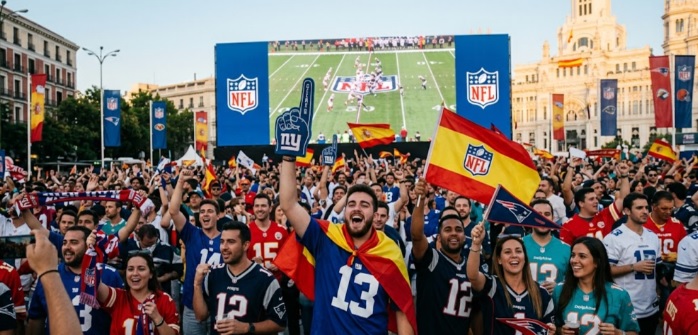
American football is very much pushing beyond its traditional borders and you can see it taking hold in new places. Spain, long defined by its passion for soccer, is quickly becoming one of the NFL’s most promising international markets. With Madrid set to host regular-season action and fan interest climbing, the shift is hard to ignore.
You might still associate Spain with the dominance of the round ball, but that picture is really starting to change. The sporting landscape is evolving and American football is finding space within it.
The NFL is no longer treating Spain as a secondary audience. Instead, it is positioning the country as a key part of its European growth strategy. This goes beyond staging a single game abroad. It reflects a broader change in how the league connects with global audiences and how you experience sports across cultures.
The Strategic Migration to Madrid
Bringing a regular-season game to the Santiago Bernabéu Stadium signals a clear intent. This is not an experiment. It follows a model that has already worked in London and Germany, where the NFL has built strong followings by hosting games in major venues.
By choosing iconic stadiums, the league ensures the atmosphere is as close as possible to that of a high-stakes game in the United States.
When you look at engagement levels in Spain, it becomes clear that this is more than casual interest. Fans are not just watching highlights.
They are learning the structure of the game, from offensive systems to defensive strategies. That deeper level of understanding often overlaps with other forms of digital engagement. Some fans who enjoy the analytical side of football also explore platforms like Toroslots.com, drawn to experiences that reflect similar layers of decision-making and risk.
This overlap says something about the modern fan. You are not just consuming sport; you are interacting with it in different ways.
Building a Local Football Culture
Sustained growth depends on more than occasional international games. It requires local roots. That process is already underway in Spain.
Flag football programs are expanding and media coverage in Spanish is becoming more accessible. The sport is being introduced to younger audiences who may have grown up following soccer icons but are now learning the fundamentals of American football.
Several factors are supporting that growth. Live broadcasts are easier to access through streaming platforms, making it simpler for you to follow games regularly.
Social media content is being tailored to Spanish audiences, reflecting local humor and cultural references. Spanish-speaking ambassadors are helping bridge the gap between American football and European fans. Marketing partnerships with local figures are also helping make the sport feel more familiar.
The numbers back this up. According to the NFL’s early 2024 data, there are already more than 13 million fans in Spain. That places the country among the league’s most significant international markets.
Viewership during the 2023 season also increased by 20 percent compared to the previous year, based on the NFL’s February 2024 International Growth Report.
The Economic Impact of International Games
When the NFL arrives in Madrid, the impact extends well beyond the stadium. You are looking at increased tourism, higher demand for hospitality services and a surge in global media attention. Moving two professional teams across continents is complex, but the long-term value lies in building lasting connections with new audiences.
Local businesses benefit as well. Bars and restaurants see increased traffic as fans gather to watch games, which are often scheduled in the evening due to time zone differences.
These events create an atmosphere that feels similar to major European soccer nights. The NFL’s ability to turn a single game into a broader social experience is one of its strengths and it is resonating in Spain.
A New Era of European Sports Consumption
Your relationship with your favorite team is evolving and so is the NFL, which adapts to the new realities. Football watching is just one of many ways to connect with your team. People living in Spain become active participants in fantasy leagues, discuss their teams online and continuously monitor off-season events.
As a result, people remain interested year-round, not just during games. It means that you will be more interested in storylines, players' movements and strategies used during the season.
As the boundaries between territories fade, American football in Spain serves as a bridge between cultures. The game becomes a space where two distinct sports cultures meet, creating shared topics to discuss.
You become part of a new type of audience whose location no longer matters, but whose active participation in discussions does. Your approach changes how fans in other leagues perceive the sport and even shapes its future.
Looking Ahead to a Global Gridiron
There is no doubt about this. In the coming years, the NFL will expand overseas and Spain will play a major role in this process.
There will be more games, closer interaction with locals and greater investment in the market from the league’s side. The NFL focuses on building long-term relationships with fans and appreciates local traditions rather than imposing a one-size-fits-all strategy.
This is only a first step in a more significant process of transformation. By referring to American football as an "American" phenomenon, one should understand it as something that serves as a criterion rather than a geography-related one. This sport is spreading fast and in Spain, one can see a rapid pace of acceptance and adaptation by local communities.
Local groups start participating actively, forming clubs and developing their unique understanding of the game.
 Charlie Campbell