 Walt
Walt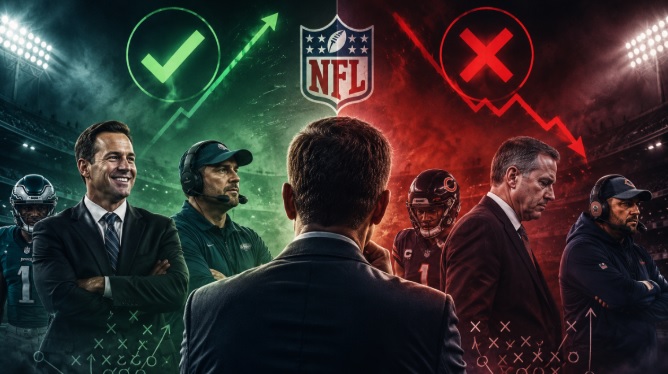
Ten franchises changed head coaches during the 2026 offseason, tying a league record shared with 1978, 1997, 2006 and 2022. Some of those decisions already look inspired. Others may haunt their owners for a decade. Any appointment has short-term and long-term consequences on a team performance, subsequent squad changes, and changes of odds at the ggbet platform. This breakdown grades the boldest moves of recent years and attempts to separate the visionary decisions from the panicked ones.
Why coaching decisions define the NFL more than ever
The growing pressure to deliver instant success
Patience has vanished from NFL boardrooms. Only nine head coaches have held their current jobs for four full seasons, and the 2026 carousel produced ten NFL head coach openings in a single winter. When Mike Vrabel and Ben Johnson turned losing rosters into contenders within months, every owner started asking why their own rebuild needed three years.
How ownership expectations shape hiring and firing decisions
The average NFL franchise is now valued above seven billion dollars, and owners treat coaching seats accordingly. Buffalo dismissed Sean McDermott two days after a divisional-round exit, even though his Bills were one of only four teams ever to win a playoff game in six consecutive seasons. Results alone no longer guarantee survival; trajectory and style matter just as much.
Why the right coach can transform an entire franchise
New England is the clearest proof. The Patriots went 4-13 in 2024, hired Vrabel, and finished 14-3 a year later - a ten-win improvement that tied the largest ever recorded by a team with a new head coach. One appointment converted a bottom-five roster into a Super Bowl finalist without a single blockbuster trade.
The biggest NFL coaching hires that changed everything
Landmark appointments that led to championships
Kansas City hiring Andy Reid in 2013 remains the gold standard: three Lombardi Trophies and more than a decade of dominance followed. Seattle's 2024 gamble on Mike Macdonald belongs in the same conversation already. Two years after arriving, he lifted the trophy at Super Bowl LX, beating the Patriots 29-13 as the third-youngest champion coach in history.
Unexpected hires that exceeded expectations
Nobody projected instant glory when these appointments were announced, yet each reshaped its franchise:
- Sean McVay, hired by the Rams at 30, delivered a Super Bowl within five years and redefined offensive football.
- Mike Tomlin took over Pittsburgh at 34 in 2007 and never produced a losing season across nineteen campaigns.
- Liam Coen, absent from most shortlists, guided Jacksonville to an 11-4 record and a playoff berth in his debut year.
Rookie head coaches who quickly proved themselves
Ben Johnson waited years for the right opportunity, then justified Chicago's $13 million annual investment immediately, dragging the Bears to the divisional round in his first season. Macdonald and Coen followed similar arcs. The lesson: preparation and scheme identity travel better than name recognition.
Coaching hires that failed to meet expectations
High-profile appointments that never worked
Urban Meyer lasted thirteen games in Jacksonville despite three college national titles. Nathaniel Hackett was gone from Denver before his first December ended. Pete Carroll's Raiders reunion collapsed after one season, and Las Vegas moved on to Klint Kubiak fresh off Seattle's championship run. Reputation, clearly, is not a game plan.
Common mistakes teams make during the hiring process
Failed searches tend to repeat the same errors:
- Chasing the coordinator behind last season's trendiest offense without checking leadership credentials.
- Ignoring roster fit and forcing a scheme onto players built for the opposite style.
- Letting ownership impatience compress the interview process into a public-relations exercise.
Why great coordinators don't always become great head coaches
Calling plays is one skill; managing a hundred-person organization is another. Josh McDaniels engineered brilliant Patriots offenses yet failed twice as a head coach. The coordinators who succeed after promotion - Macdonald, Johnson, Coen - combined tactical brilliance with delegation and locker-room authority, qualities interviews often fail to measure.
The NFL's most controversial coaching firings
Firings that looked harsh but proved to be the right decision
Seattle nudging Pete Carroll aside in 2024 felt brutal after fourteen seasons and a title. Two years later, the franchise owned another ring under the youngest NFL coach hired that cycle. Sometimes a respectful goodbye at the right moment beats loyalty that lingers a season too long.
Coaches dismissed despite respectable records
Baltimore firing John Harbaugh on January 6, 2026 stunned the league. He was the franchise's all-time winningest coach and had signed a contract extension worth roughly $16 million per year only ten months earlier. An 8-9 season ended eighteen years of stability - and instantly created the most coveted free agent in coaching.
When ownership moved too quickly after one disappointing season
Pittsburgh's divorce from Mike Tomlin after a 30-6 wild-card humiliation against Houston divided opinion sharply. Nineteen seasons without a losing record earned him no grace period. Replacing him with 62-year-old Mike McCarthy is a bet that experience will outperform continuity; the evidence for that theory remains thin.
Franchises that benefited most from making bold changes
Teams that rebuilt through leadership changes
The Giants absorbed years of ridicule before striking decisively, handing Harbaugh a five-year, $100 million contract within days of his Baltimore exit. New York paired him with coordinators Matt Nagy and Dennard Wilson, giving a wandering franchise its most credible leadership group since the Coughlin era.
How front offices supported successful coaching transitions
Seattle shows what alignment looks like. General manager John Schneider, voted the league's top executive for 2025, rebuilt the roster around Macdonald's defensive vision and acquired Sam Darnold to stabilize the offense. Coaches rarely fail alone; they fail inside front offices that hand them broken rosters and impossible timelines.
The long-term impact on playoff appearances and championships
Bold, well-timed changes compound. The Seahawks converted one hire into a No. 1 seed and a championship. New England converted another into a conference title within twelve months. Franchises that dithered, like Cleveland and Carolina, spent the same period collecting draft picks and empty Januaries.
When keeping a coach would have been the better move
Cases where patience could have produced better results
Tennessee firing Vrabel after the 2023 season now looks like the costliest dismissal of the decade. The Titans have since restarted twice, hiring Robert Saleh in 2026, while their former coach collected hardware in New England. Denver's post-Payton stability, by contrast, shows what holding steady can deliver: an AFC top seed.
Coaches who found success after leaving their former teams
Bill Belichick left Cleveland a punchline and became the greatest coach ever in New England. Carroll turned a Patriots failure into a Seattle dynasty. Vrabel needed one season to make Tennessee look absurd. Harbaugh required eleven days to turn his firing into a $20 million annual salary elsewhere.
Lessons learned from premature dismissals
The pattern is consistent: organizations fire proven leaders during temporary dips, then watch them flourish where infrastructure is better. Before pulling the trigger, smart owners now ask whether the roster, the quarterback situation or the salary cap (rather than the coach) explains a disappointing year.
What separates successful NFL coaching hires from costly mistakes
Leadership qualities that consistently produce winning teams
At his Seattle introduction, Macdonald promised "to bring a championship back to Seattle and the 12s" - and delivered within two years. Winning hires share that clarity of purpose, plus adaptability and the credibility to hold stars accountable. Charisma without substance, as several failed tenures proved, survives roughly one losing streak.
The importance of roster fit and organizational culture
Vrabel succeeded partly because New England's roster suited his physical identity, and partly because free-agent additions like Stefon Diggs and Milton Williams were chosen to match it. Hiring a coach whose philosophy contradicts the existing personnel forces a multi-year teardown that most owners lack the stomach to finish.
Balancing analytics, experience, and player development
The best modern staff blend all three. Macdonald pairs data-driven defensive design with old-school fundamentals. Johnson builds analytics into every play sheet while developing quarterbacks patiently. Teams that lean entirely on gut feel, or entirely on spreadsheets, keep discovering that championship football lives somewhere between the two.
How modern NFL hiring trends are changing the league
The rise of offensive-minded head coaches
Quarterback development drives the market, so play-callers command premium salaries - Johnson's Chicago deal being the loudest example. Yet the pendulum swings both ways: defensive minds Macdonald, Saleh, Jesse Minter and Jeff Hafley all landed top jobs recently, proof that stopping modern offenses is worth as much as running one.
Younger candidates versus experienced veterans
The 2026 cycle showcased both extremes. Buffalo promoted 36-year-old Joe Brady, currently the youngest NFL coach, while Pittsburgh chose McCarthy at 62. Anyone wondering who is the highest paid NFL coach among newcomers should watch Brady's next contract; success in Buffalo would make him the market's defining bargain.
Diversity initiatives and expanding coaching opportunities
The Rooney Rule keeps evolving, and pipelines matter more than mandates. Coordinators such as Wilson in New York and Hafley in Miami advanced through expanded interview requirements and coaching fellowships. Progress remains uneven, but the 2026 cycle featured a broader, deeper candidate pool than any hiring window before it.
Grading the NFL's biggest hire and fire decisions
Below you can see the biggest decisions in the reviewed area. Polish bettors weighing the knock-on effects typically read independent user reviews of gg bet polska before committing to season-long positions.
|
Move |
Grade |
Verdict |
|
Seahawks hire Macdonald (2024) |
A+ |
Champion at 38 |
|
Patriots hire Vrabel (2025) |
A |
Ten-win turnaround, Super Bowl trip |
|
Ravens fire Harbaugh (2026) |
D |
Gifted a rival a legend |
|
Bills fire McDermott (2026) |
C- |
Harsh; Brady must justify it |
|
Titans fire Vrabel (2023) |
F |
The decade's worst dismissal |
Best hiring decisions of the modern era
Reid to Kansas City, McVay to Los Angeles, Macdonald to Seattle and Vrabel to New England form the modern Mount Rushmore of appointments. Each combined bold timing with organizational alignment. Notably, three of the four were first- or second-time head coaches rather than recycled celebrity names.
Most regrettable coaching dismissals
Tennessee firing Vrabel loose tops the list, with Baltimore's Harbaugh decision close behind. Both men were named NFL Coach of the Year at some point in their careers - Vrabel has now won it twice, with two different franchises - which underlines how rarely available coaches of that caliber should be released.
The franchises that consistently make the smartest leadership decisions
Answering who is the highest paid coach in the NFL reveals the smartest employers. Kansas City pays Reid $20 million annually and considers it cheap; the Giants matched that figure for Harbaugh. Pittsburgh, Green Bay and Baltimore historically prized continuity, though two of those three just abandoned the philosophy. Seattle, meanwhile, keeps timing every transition perfectly.
FAQ
Who is the highest paid NFL head coach in 2026?
Andy Reid and John Harbaugh share the top spot at $20 million per year, with Sean Payton next at $18 million. The highest paid coach in NFL history by career earnings remains Bill Belichick (as it is known according to available data).
Who won NFL Coach of the Year for the 2025 season?
Mike Vrabel of the New England Patriots, ahead of finalists Liam Coen, Mike Macdonald, Ben Johnson and Kyle Shanahan.
Who is the youngest NFL head coach right now?
Joe Brady of the Buffalo Bills, promoted in January 2026 at age 36 - two years younger than Super Bowl winner Mike Macdonald.
How many teams changed head coaches for the 2026 season?
Ten, tying the all-time single-offseason record previously reached in 1978, 1997, 2006 and 2022.
Do coaching changes affect betting odds?
Significantly. Sportsbooks reprice win totals, division futures and championship odds as soon as major news breaks, which makes the carousel one of the most tradeable offseason events.
 Charlie Campbell