 Walt
Dante Moore may already be living the most dangerous chapter of his career
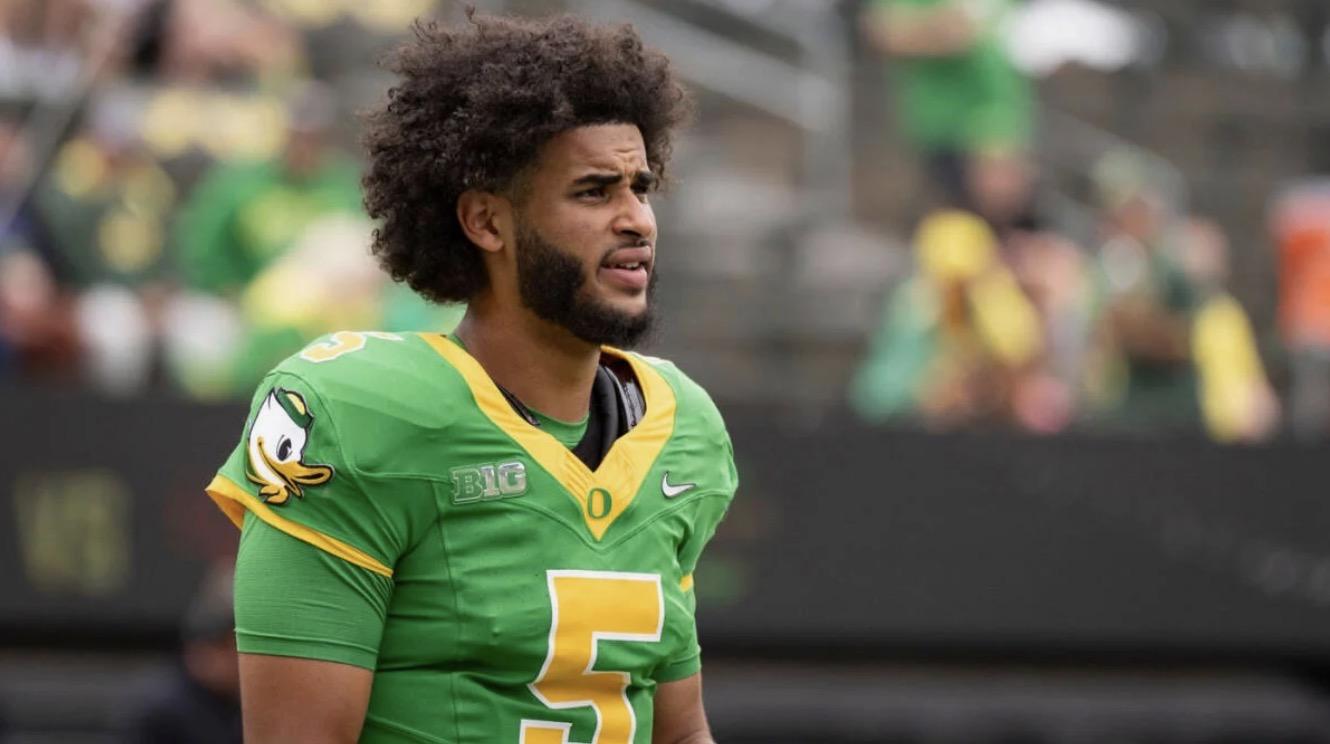
The plan for Dante Moore for this year was to hone a premier arm, layer tape, and lead Oregon through a season defined by his control. However, the plot took an entirely different, less favorable turn. Following the head injury he suffered during the game against USC on September 26, Oregon coach Dan Lanning stated in late October that the quarterback is unlikely to play the rest of this season.
That shift matters well beyond one depth chart. In college football, where betting chatter and quarterback volatility feed each other almost by reflex, even a name like Duckysino can slide naturally into the middle of the conversation once Dante Moore leaves the field. The mood around Oregon changes fast, moving from breakout expectation to damage control. That kind of swing always bleeds into how people price futures, roster stability, and transfer-era uncertainty.
Dante Moore Oregon and the season that bent out of shape
The injury was certainly not some general set back in training or some obscure medical problem. According to ESPN, he was injured during a slide play in the second quarter when playing against USC. It was mentioned that this injury led to a targeting call and an ejection for USC linebacker Desman Stephens II. Moore left the field in a stretcher and went to Los Angeles General Medical Center via ambulance. Lanning mentioned afterwards that his MRI and CT scans had come out clean without any other injuries.
That is the brutal part of concussion coverage in football: normal imaging can coexist with a recovery path that refuses to behave on schedule. The Dante Moore Oregon storyline became more complicated once the immediate fear passed, because the next stage was not about structural damage on a scan. It turned into something about symptoms, neurological responses, tolerance for exertion, and the ability of a quarterback to safely process speed, pressure, movement, balance, and decisions at full speed.
Dante Moore age makes the timeline feel heavier
OregonLive, quoting Dylan Rogers from OHSU, said that although some players would come back in two to four weeks, each concussion is unique, and the process is based on steps and not days. It starts with symptom-limited exercise, followed by aerobics, individual football exercises, non-contact practice, full practice, and unrestricted competition at last. The symptoms may improve, recur, and cause resetting of the whole procedure. In Dante Moore’s case, such uncertainty converted a potential recovery during a week off into the entire season decision.
This is where the search phrase Dante Moore age stops being trivia and starts reading like a football question with financial consequences. He is an upperclassman on the Oregon squad slated for 2026, standing 6-foot-3 and 220 pounds, a blue-chip arm out of Detroit whose professional career lies ahead of him. A young backup player with just one shot at it may be eager to return to action. A talented prospect who has already been a draft-able prospect and can still play one more year of college ball has more reason to heed a coaching staff’s advice to wait.
Dante Moore high school stardom still colors the debate
One reason for the strong public reaction is due to the fact that Dante Moore’s reputation precedes the season. He entered the national limelight as an excellent QB recruit whose name had some clout during the recruiting process, then came back to play for Oregon in 2026 after he passed up on the chance to enter the NFL Draft, which was already generating talk of top pick selection.
The Dante Moore high school label still shadows every discussion because elite prep quarterbacks are often sold as future-proof assets, almost immune to turbulence once they reach a major program. The reality is messy. College development usually doesn’t follow a nice linear path, and there’s nothing neat and tidy about the timelines that are blown to pieces by concussion cases. Arm ability isn’t gone, but a missed season may still screw up how people look at readiness and projection.
Why Dante Moore height does not protect a quarterback from this kind of hit
Dante Moore's height is listed by Oregon at 6-foot-3, which sounds sturdy enough to survive the weekly punishment of college football, but this injury reminded everyone how little frame size matters when the brain is involved. In its medical analysis of what happened, OregonLive described how viewers witnessed the athlete’s fencing reaction when he hit his head on the ground. The medical breakdown explained that such a reaction indicates the brain injury process but not the severity of the brain damage process. This is very important.
The phrase Dante Moore height also misses the larger football point. Quarterbacking at this level depends on speed of thinking, visual discipline, timing, sense of space, and reset ability in the presence of noise. The concussion treatment is not only about headaches going away. It is about how well these systems are functioning now, despite being invisible to everyone else. This is why Lanning’s words were so significant when he stated that the player was able to recover completely, but he was still not going to play again this year. It sounded like an acceptance of the harsh reality rather than panic.
The career effect may be slower, stranger, and more political than people think
It is clear, at least in the short run, that the Ducks are without their offensive plan based on Moore's ceiling, while the player himself will be without the practice reps needed to further develop his game in front of scouts and when talking about his NIL value. In the long run, the situation gets a little more nuanced. Some people may say that this decision was one of the best that could've been made, as it is preserving the future of the player, avoiding a potentially ugly situation with a second concussion before resetting neurologically.
This is where the speculation begins to heat up, despite the fact that the hard facts are few. There are no known twists in the story at present. Only a handful of facts have come to light. He was not cleared to play. It is believed that he will miss the remainder of the season. NBC Sports pointed out another important fact regarding the NCAA rule change that he will be eligible for college football in 2027 and can delay his entry into the NFL draft until 2028. Therefore, what seems like a rumor is really a certainty.
In that scenario, the reputational fallout will not be nearly as big as the timing issues. There have been seasons lost in the NFL before, particularly when the time away was the result of prudence as opposed to subpar performances on the field. The bigger concern is that of story line erosion. Once the signal caller goes missing for weeks at a time, people begin reimagining his story for him. He becomes fragile, stuck, incomplete, or just plain unlucky. For Dante Moore, the real challenge is beating those narratives before anyone else.
 Charlie Campbell