 Walt
The adjusted line, payout and settlement rules all belong to the same decision.
A favorite is -8.5. An underdog in a different game is +1.5. A six-point teaser bet turns them into -2.5 and +7.5: the favorite can win by a field goal, and the underdog can lose by a touchdown. It is a tidy-looking ticket. Then the sportsbook quotes -140. Do you still want it? This fictional pair shows why the answer has to involve more than finding two teams that seem unlikely to get blown out.
A teaser bet can turn on half a point
The favorite's original spread is doing important work. Six points of protection only make sense once you know exactly where they leave you.
A book dealing -9 produces a different ticket from one dealing -8.5. That half-point gap in an NFL odds comparison becomes -3 versus -2.5 after the six-point adjustment. A 24–21 win pushes the -3 leg and wins the -2.5 leg. The team did exactly the same job; the two tickets did not.
A teaser combines adjusted selections on one ticket. Both legs must win for a two-team ticket to win; without pushes or voids, one loss loses the stake. Six, 6.5 and seven-point versions are common, with less generous payouts as you buy more protection. Sporting News' explanation of teasers covers that exchange. The extra points are a purchase, and the quote tells you what you are paying.
At -140, the original case needs to be stronger
Return to the fictional -2.5 and +7.5 ticket. At -120, you risk $120 for $100 profit. The whole ticket must win 120 divided by 220, or 54.55% of the time, to break even before costs. At -140, that threshold is 58.33%.
That difference is large enough to reverse a decision. Suppose, purely for illustration, each adjusted leg has a 75% chance of winning and the results are independent. The chance of both winning is 0.75 × 0.75 = 56.25%. Under those assumptions, -120 has positive expected value and -140 has negative expected value. Nothing changed about either football game.
Those 75% estimates are invented, not a claim about how often this type of teaser wins. Real probabilities are harder to establish. The example simply identifies the question your analysis must answer.
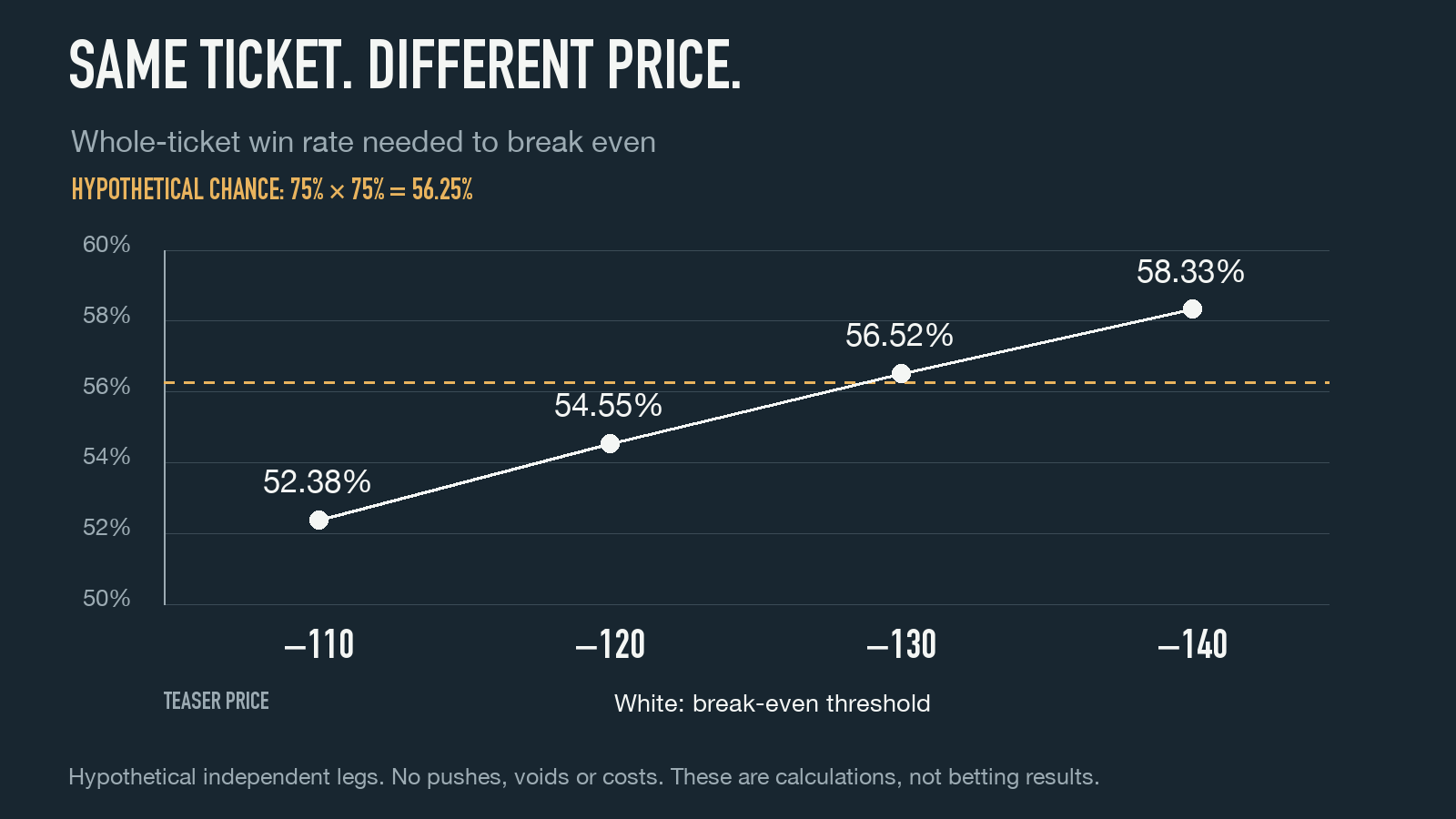
Calculated thresholds, not a record of betting results. The dotted line assumes two independent legs with a 75% chance each; pushes, voids and costs are excluded.
If both legs are equally likely and independent, the individual break-even probabilities are about 73.85% at -120 and 76.38% at -140. You get those figures by taking the square root of the whole-ticket requirement. “I expect both teams to keep it close” is not yet evidence that either threshold has been cleared.
A six-point teaser around -120 is a useful reference example, not a price every sportsbook offers. Compare the product actually on the bet slip. A different payout, a different starting spread or a different push rule changes the calculation.
Why these spreads keep coming up
Three and seven are central NFL margins because of the scoring system: three points for a field goal, seven for a touchdown followed by a successful extra-point kick. When a spread moves through one of those numbers, it changes the treatment of an outcome that matters to the bet.
That is the appeal of six-point adjustments on favorites from -7.5 to -8.5 and underdogs from +1.5 to +2.5. A favorite at -8.5 becomes -2.5, moving through both seven and three. An underdog at +1.5 becomes +7.5, gaining protection against losses by either margin.
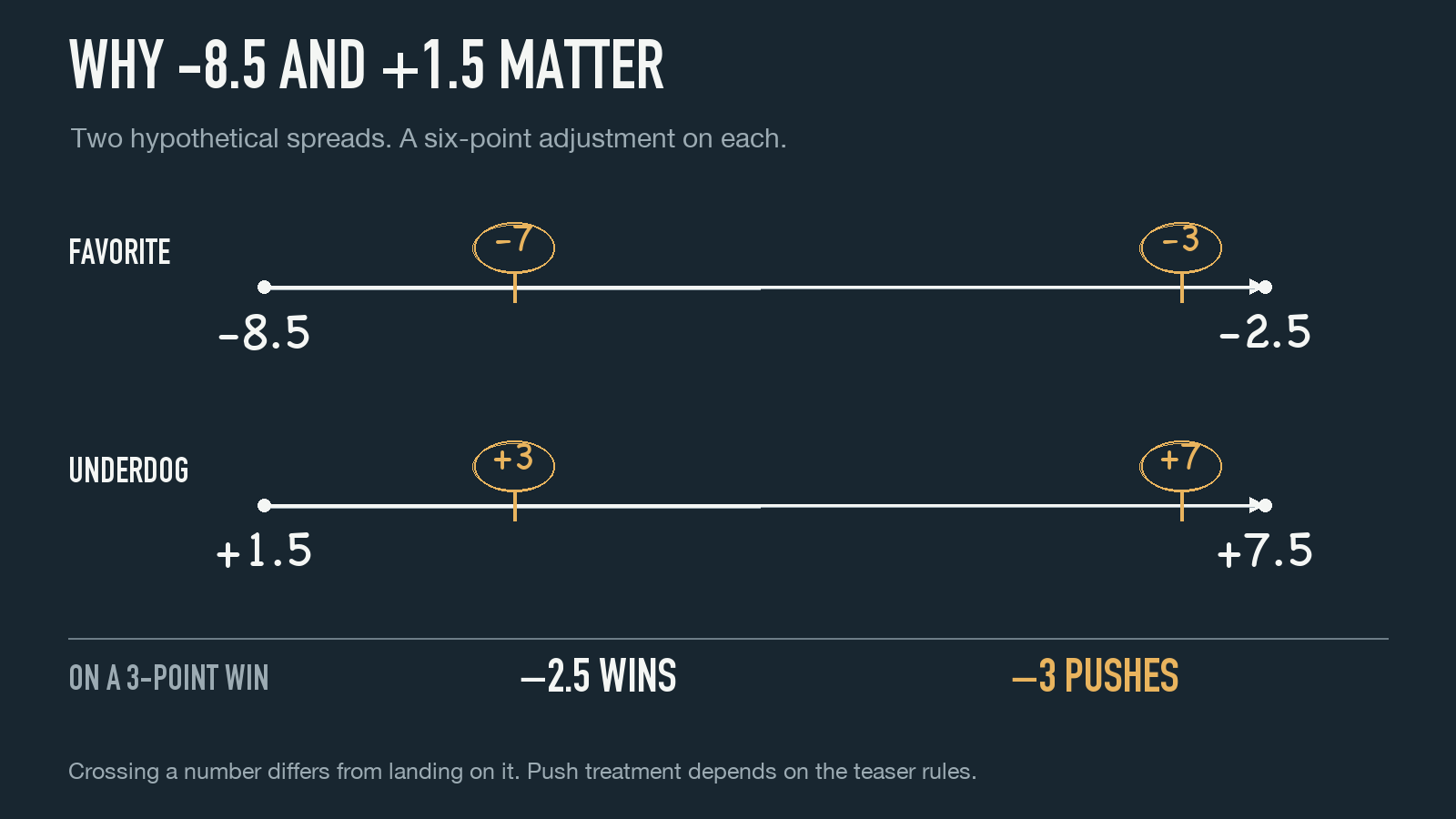
Six points cover different outcomes depending on where the adjustment starts. All lines shown are hypothetical.
The endpoints still matter within those ranges. Starting at -7.5 leaves -1.5, so a two-point victory wins the leg. Starting at -8.5 leaves -2.5, which needs a three-point win. Both cross three and seven; the first is the better line if everything else is equal.
In a historical example, theScore's analysis of key-number pricing shows how sharply alternate-spread prices can change around seven. It helps explain why counting the points alone is inadequate. Six points across useful margins and six points through less useful territory are different purchases.
The rule that can change a winning Sunday
Now suppose you accepted -9 as the starting line. Your adjusted favorite is -3 and wins by exactly three. That is a push on the spread, not a losing football prediction. What happens to the teaser depends on the sportsbook's rules.
Some products reduce a ticket after a push; others refund it or treat the tied leg as a loss. The other leg's result may affect settlement, and special teaser products can have different terms. Read the rule for the exact ticket, including a push paired with a loss. Do not assume the treatment matches a straight spread bet.
A tied football game is a separate issue. An underdog at +7.5 covers if the final score is tied. The wager is settled against the adjusted spread, not simply whether the team won outright. Our sports betting FAQ explains the distinction between a spread and a straight-up result.
Keep the second leg on trial
Finding one strong candidate does not create a reason to add another. The second leg has to justify its place at the same payout. If it is there because you need a partner for the first team, the analysis has run backward.
For each matchup, identify what could defeat the adjusted line: quarterback uncertainty, protection problems, a bad defensive matchup or a meaningful injury. The matchup arguments in our picks against the spread are useful material to evaluate, but an opinion about the original spread is not automatically an argument for a teaser.
Be particularly careful with high-total games. Six points may offer less protection in a matchup expected to produce plenty of scoring. A lower total can help screen candidates, but it does not establish value by itself.
Other adjustments spend points without crossing both target numbers. Moving -3 to +3 goes through zero and lands on three. Moving -12 to -6 crosses seven but misses three. Neither is the same situation as -8.5 to -2.5. Teasing totals requires its own analysis, too; the logic of winning margins cannot simply be applied to combined points.
The original ticket is worth considering only if both matchup cases survive, the payout is acceptable and the rules are clear. It is also a perfectly good decision to leave it unplaced.
Teaser questions that come up on Sundays
Is a teaser safer than a parlay?
The adjusted lines are easier to cover, but the payout is lower. A higher win probability does not by itself make the price attractive.
Why not buy seven points every time?
The extra protection costs more. Compare the outcomes it adds with the reduction in payout rather than assuming more points are always better.
Does crossing three and seven guarantee value?
No. It identifies a useful spread pattern. The teams, exact lines, price and settlement rules still determine the wager.
Can a push lose the ticket?
Yes, under some teaser rules. Read the terms for the specific product before staking.
21+ only. Bet only where legal, set a spending limit and never chase losses.
 Charlie Campbell