 Walt
Walt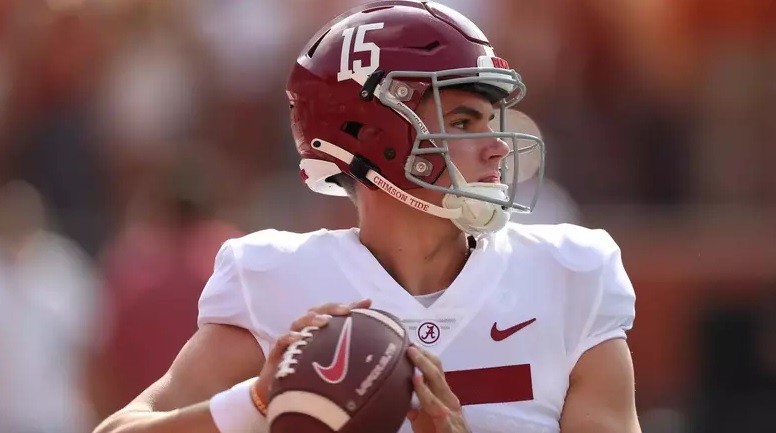
The Las Vegas Raiders are staring at the kind of organizational crossroads that defines decades. As of February 17, 2026, they are locked into the No. 1 overall pick following a disastrous 2025 campaign, and the quarterback vacuum in Las Vegas has become impossible to ignore. Geno Smith underperformed. The roster cracked. The locker room wobbled. Now, with a new regime led by Klint Kubiak and a fan base demanding clarity, the franchise is pinned between consensus and chaos. This is not just about selecting a prospect; it is about whether one decision can stabilize a franchise that has spiraled into irrelevance.
The “Mendoza to the Desert” Mandate
The gravitational pull around Indiana’s Fernando Mendoza (6-5, 225 lbs) has become overwhelming inside draft circles, and the Raiders’ position at No. 1 overall has only intensified that momentum. Mendoza’s résumé is heavy and impossible to sidestep: Heisman winner, architect of a 16-0 national championship run, and the owner of a prototype frame at 6-5 and 225 lbs that fits the NFL’s preferred mold. His season was not a flash of statistical noise; it was sustained dominance against top-tier competition, culminating in a perfect 16-0 march to a national title. Evaluators who describe his ceiling as “Matt Ryan-plus” are not tossing out lazy comparisons—they are pointing to anticipatory throws, command at the line of scrimmage, red-zone precision, and the type of leadership that can steady a franchise drifting without direction. The consensus around Mendoza as the unanimous projected top pick gives Las Vegas clarity, but clarity does not eliminate risk. It simply narrows the margin for error when the entire league expects one outcome.
Klint Kubiak’s First Major Test
Klint Kubiak’s arrival adds another layer of intrigue because the new head coach has already admitted “limited exposure” to the 2026 QB class, a candid remark that sent a ripple through scouting circles. When a coach standing at the threshold of the No. 1 overall pick acknowledges limited familiarity with the quarterback pool, it reframes the evaluation process as both urgent and fragile. The Raiders’ front office has articulated a plan to construct a “team of teachers” around their future signal-caller, emphasizing infrastructure over improvisation. That phrase signals an intent to insulate a rookie with quarterback tutors, technical specialists, and schematic continuity rather than simply handing him a playbook and hoping raw talent prevails. For Kubiak, this draft is not a ceremonial first pick—it is the foundation of his tenure. The synergy between coaching philosophy, scouting conviction, and ownership patience will determine whether this decision sparks a renaissance or deepens skepticism surrounding the Raiders’ leadership.
The Analytics Warning: Pressure and Negative Plays
Even prospects crowned with a Heisman and a 16-0 national championship run carry blemishes, and Mendoza’s profile includes a statistic that cannot be ignored: a high pressure-to-sack rate (P2S%) that mirrors Justin Fields. Analytics departments increasingly view P2S% as a quarterback-influenced metric rather than a pure offensive line indictment, measuring how often pressure converts into a sack and revealing processing speed, pocket awareness, and decision-making under duress. That parallel to Justin Fields raises legitimate questions about whether Mendoza holds the ball too long or trusts his arm strength to outlast collapsing pockets. The context in Las Vegas only heightens concern because the Raiders fielded a league-worst offensive line, amplifying every vulnerability at quarterback. Drafting a passer with a Justin Fields-like P2S% into an environment that already hemorrhages pressure invites volatility. The Raiders must dissect whether Mendoza’s sack tendencies are correctable through coaching and scheme adjustments or whether they represent a structural limitation that will persist at the professional level.
Draft Strategy: The “King’s Ransom” vs. The Solution
Holding the No. 1 overall pick presents Las Vegas with leverage few franchises experience, but leverage invites temptation. The Raiders could command a “king’s ransom” from quarterback-needy teams desperate to leap to the top, potentially extracting multiple first-round selections, premium day-two assets, and future flexibility that reshapes the roster beyond 2026. At the same time, the looming presence of 2027’s touted class, headlined by Arch Manning, complicates the timeline and fuels arguments for patience. Staying at No. 1 and selecting the perceived solution in Mendoza offers immediate clarity; trading back opens pathways toward depth accumulation and long-term maneuverability.
Exploring different outcomes in a 2026 NFL mock draft simulation highlights how one decision at No. 1 can reshape the entire board, altering positional runs and redistributing quarterback supply. Walter’s projections remain the industry benchmark, but simulations reveal alternate realities where depth triumphs over singular star power. The Raiders must decide whether to pursue certainty now or gamble on strategic patience that could either multiply assets or postpone resolution.
The High-Risk Alternative: Ty Simpson
Consensus can sometimes suffocate creativity, and Alabama’s Ty Simpson represents the volatile counterargument to the Mendoza mandate. Passing on a Heisman winner with a 16-0 national championship run for Simpson would qualify as a “Las Vegas gamble,” yet it is a path some evaluators whisper about in closed rooms. Simpson’s athletic upside and developmental ceiling attract scouts who prioritize traits, explosiveness, and long-term projection over collegiate accolades.
His Alabama pedigree ensures exposure to pro-style demands, but his profile carries more raw edges and mechanical variance than Mendoza’s. Choosing Simpson at No. 1 overall would ignite immediate backlash, yet it would also signal conviction in upside rather than consensus. Such a selection would not exist in a vacuum; it would ripple across the draft board, scrambling quarterback hierarchies and forcing teams to recalibrate their strategies in real time. For a franchise with a history of bold swings, the temptation to zig while the league zags is real, but so is the margin for catastrophic miscalculation.
The Bridge Dilemma: Geno Smith’s Stopgap Role
Geno Smith’s underperformance in 2025 catalyzed the Raiders’ descent to the No. 1 overall pick, yet his contract and experience complicate the path forward. A controversial theory circulating in league circles suggests retaining Smith as a “bridge” starter, shielding Mendoza—or even Ty Simpson—from immediate exposure behind a league-worst offensive line. The bridge model prioritizes development, granting a rookie time to acclimate to NFL speed while absorbing the playbook under less public pressure. However, locker-room dynamics can fray when veterans sense a transitional season, and fans in Las Vegas rarely embrace delayed gratification. Keeping Smith as a stopgap could stabilize early turbulence, but it also risks prolonging the uncertainty that defined 2025. The Raiders must weigh optics, competitive integrity, and developmental pacing with surgical precision because mishandling the quarterback timeline can fracture trust both inside the building and across the fan base.
Ownership Pressure and Front-Office Cynicism
The Raiders’ recent history has cultivated cynicism, and ownership cannot escape scrutiny as this decision approaches. Drafting at No. 1 overall magnifies every internal debate, every leaked rumor, and every hint of discord within the scouting department. Past missteps linger in the collective memory of the fan base, fueling skepticism about whether the franchise can execute a straightforward evaluation without overthinking the moment. The choice between Fernando Mendoza (6-5, 225 lbs), armed with a Heisman and a 16-0 national championship run, and alternative strategies involving Ty Simpson or a trade for a “king’s ransom,” will define narratives for years. Front-office cohesion must be airtight; public fractures would erode confidence instantly. Ownership pressure intensifies when losses accumulate, and the Raiders’ leadership must demonstrate a unified vision rather than reactive decision-making driven by headlines or fan impatience.
Fantasy Football Fallout for 2026
The ripple effects of the No. 1 overall pick extend beyond Las Vegas and into fantasy football markets preparing for 2026. A Heisman winner with a 16-0 national championship run landing in a major market franchise generates immediate attention in redraft and dynasty formats. Mendoza’s “Matt Ryan-plus” ceiling tantalizes managers seeking long-term stability, yet his high pressure-to-sack rate (P2S%) mirroring Justin Fields introduces volatility that fantasy owners cannot ignore, particularly behind a league-worst offensive line. Geno Smith remaining as a bridge would suppress early projections, while a bold pivot to Alabama’s Ty Simpson would recalibrate dynasty boards overnight due to his athletic upside and developmental intrigue. Fantasy football ecosystems respond swiftly to draft capital and coaching narratives, and the Raiders’ choice will influence average draft position, trade valuations, and roster construction strategies across formats.
The Raiders’ Dilemma: Can a single draft pick solve the quarterback vacuum in Las Vegas? The franchise stands at a volatile intersection of consensus and courage. With Fernando Mendoza (6-5, 225 lbs), a Heisman trophy, and a 16-0 national championship run commanding the spotlight, alongside a high pressure-to-sack rate (P2S%) that mirrors Justin Fields and the burden of a league-worst offensive line, the variables are stark. Klint Kubiak’s “limited exposure” admission and promise to build a “team of teachers” underscore the developmental stakes. Whether Las Vegas selects the unanimous top prospect, gambles on Alabama’s Ty Simpson, trades for a “king’s ransom,” or delays transition behind Geno Smith, one card at No. 1 overall will either ignite renewal or deepen the void that has swallowed the Raiders since their disastrous 2025 campaign.