 Charlie Campbell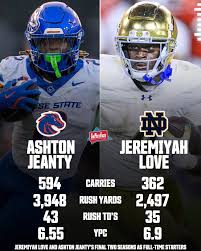
Running Back Class
Early-round talent: C-Mid-round: C
Late-round: C-
Overall grade: C-
2025 prospects vs 2026
Jeremiyah LoveAshton Jeanty
Omarion Hampton
Quinshon Judkins
TreVeyon Henderson
Jadarian Price
R.J. Harvey
Mike Washington Jr.
Jonah Coleman
Nick Singleton
Just to be clear, this article and series are all my opinion. I base my evaluation on my own film study and also on information I’ve gotten from general managers, directors of college scouting, national scouts, area scouts, and NFL coaches who know way more than I do.
The 2025 class was a strong year for running backs, and much better than this year. However, if you were to merge the two classes together, Jeremiyah Love would be on the top as he is a better prospect than Ashton Jeanty or Omarion Hampton. Jadarian Price is a second-round prospect on a par with R.J. Harvey and behind Quinshon Judkins and TreVeyon Henderson. Mike Washington Jr., Jonah Coleman, and Nick Singleton would be behind Harvey.
Safest Pick: Jeremiyah Love, Notre Dame 
Previous Picks:2025 Jeremiyah Love
2024 Blake Corum
2023 Bijan Robinson
2022 Breece Hall
2021 Najee Harris
2020 D’Andre Swift
2019 Josh Jacobs
2018 Saquon Barkley
2017 Leonard Fournette
2016 Ezekiel Elliott
2015 Melvin Gordon
2014 Carlos Hyde
2013 Eddie Lacy
This was an easy choice as Love is one of the best prospects in the 2026 NFL Draft. Love has an excellent skill set with size, speed, athleticism, and natural running ability. Not only is he a great runner, but he is also superb in pass protection and a good receiver. Love could have a long, productive pro career.
Biggest Bust Potential: Mike Washington Jr., Arkansas 
Previous Picks:2025 Trevor Etienne
2024 Audric Estime
2023 Sean Tucker
2022 Kyren Williams
2021 Chuba Hubbard
2020 A.J. Dillon
2019 David Montgomery
2018 Rashaad Penny
2017 Wayne Gallman
2016 Kenneth Dixon
2015 Mike Davis
2014 Lache Seastrunk
2013 Montee Ball
Washington ran well at the Senior Bowl and had a great workout at the NFL Scouting Combine. However, his play speed did not match the 40 time at the combine, and the tape from his final season at Arkansas did not look like the downhill physical force at the Senior Bowl. On tape, the power and speed were not overly special. Hence, of the few early-round running back prospects this year, Washington could have the most bust potential.
Running Back Rankings by Attributes
Natural Running Ability:
NFL prototype: Saquon Barkley, Eagles
- Jermiyah Love
- Jadarian Price
- Jonah Coleman
- Nick Singleton
- Mike Washington Jr.
Recap: There are still a number of coaches in the NFL who want an old-school approach to a running-based offense. Plus, a lot of passing-led offenses want a back who can wear down defenses in the second half and clinch a win with a strong ground attack.
Love could be a bell-cow back that is the engine of a potent rushing attack. Love is a strong back who has the power to push the pile and pick up yards after contact. He has outstanding contact balance to maintain his feet while getting hit, and that leads to defenses needing multiple hits on him to get him to the turf. Love has good vision to go along with an impressive, natural feel as a runner. Love has the speed to hit the hole before it closes and good top-end speed to break off long runs. His explosiveness can be seen in his ability to hurdle and leap over tacklers at the second level. Love is a threat to rip off long runs and take any carry to the end zone. Along with having power and speed, Love has excellent elusiveness and is a creative runner. He sets defenders up with false angles and uses impressive moves in the open field to dodge tacklers. Love is a physical downhill runner with excellent vision, patience, and dynamic cutting ability. With smooth athleticism and stop-start ability, Love is special with his ability to weave through defenses. Love shows serious power to pick up yards after contact and is capable of creating on his own.
Price has the ability to be an NFL running back with a skill set to be in contention as a three-down starter early in his pro career. The first trait that generates a lot of talk about Price is his acceleration, as he has a quick first step to hit the hole and a second gear to burst to the second level of the defense. In the open field, Price can rip off yards in chunks as a threat to turn ordinary carries into big gains. Price is a one-cut, downhill, straight-line runner with a knack for ripping off long gains and scoring sprints. Aside from his quickness, Price is a natural runner with instincts. He has excellent vision and anticipation to follow his line before bursting downhill as he quickly anticipates where a hole is about to open. On top of his feel for running with the ball, he has a compact build that provides him with some power to run through tackles and pick up yards after contact. Price has plus balance to maintain his feet after getting hit by defenders, and he uses his stature to run through would-be tacklers. In the open field, Price has some moves, quick feet, and elusiveness. His strength and build make him a quality short-yardage runner as well.
As a runner, Coleman is a force. Coleman is a North-South power back who runs through contact and constantly charges through defenders. With his power and strength, Coleman was dangerous in short-yardage and goal-line situations as he is a physical runner who shows no fear to hit the hole with authority. Coleman is a decisive runner who charges downfield and is not one to dance in the backfield. He has zero hesitation to stick his nose into a scrum and power through the defense to generate positive yardage. His power allows him to finish runs well, and he consistently is dragging tacklers behind him.
Singleton is a well-rounded back who can attack defenses in a variety of ways. He has a strong build and is a physical runner who shows the strength to pick up yards after contact. Singleton has the strength to push through tacklers and finishes runs well, delivering hits to defenders and falling forward for additional yardage. At the second level, Singleton is a problem for defensive backs as he will run through them and punish them for attempting to get him to the ground. Singleton has good knee bend to run behind his pads and shows enough speed to open it up when he breaks free. While Singleton does not have elite speed for the NFL like Jahmyr Gibbs, Singleton can hit the hole before it closes and accelerate to the second level. Singleton has a natural skill set as a runner with good vision, one-cut downhill ability, patience, and some elusiveness to weave through the defense.
Washington has the talent to be a starter or a good No. 2 back in the NFL. The combination of size and speed really jumps out with Washington as he has sprinter’s speed in the open field with a strong build. However, you don’t always feel that power and speed watching Washington run. Washington needs a few steps to get going, but he has a second gear when he hits the second level with serious acceleration to run away from defenders. Washington has the bulk and power to run through arm tackles and pick up yards after contact. Washington needs to run with more anger and physicality.
Pass Receiving:
NFL prototype: Christian McCaffrey, 49ers
- Jermiyah Love
- Nick Singleton
- Jonah Coleman
- Jadarian Price
- Mike Washington Jr.
Recap: The passing-driven NFL has many offensive coordinators emphasizing running backs’ ability to help the aerial offense over their running ability. Coaches want backs who have good hands, run good routes, and can rack up yards as outlet receivers. This group is very good overall, as the majority are good receivers out of the backfield. None of them may end up being as dynamic as Christian McCaffrey or Jahmyr Gibbs, where they could legitimately line up as a slot receiver like McCaffrey or Gibbs.
Love is not as shifty as McCaffrey or Gibbs, but he could be used some out of the slot as he is fast, explosive, and sudden. Love is a nice outlet receiver with quality hands and is dangerous in the open field. In 2025, he looked improved and was a dangerous receiver. Love showed improved route-running, soft hands, and made some acrobatic catches with impressive athleticism to adjust to the ball.
Singleton can contribute to the passing offense as well. He has good hands and shows natural ability as a catcher. He runs quality routes, is smooth in space, and is dangerous after the catch. As a receiver, Coleman does a nice job for a power back. He showed the ability to contribute as a receiver with quality production through route running and reliable hands. Price did not get a lot of opportunities, but he functioned well as an outlet receiver and blocker in the passing game in limited chances. In the passing game, Washington moves well in space and shows nice athleticism as a receiver. He has soft hands and adjusts well for a big back.
Pass Blocking:
NFL prototype: Bijan Robinson, Falcons
- Jermiyah Love
- Nick Singleton
- Jonah Coleman
- Jadarian Price
- Mike Washington Jr.
Recap: This is huge for offensive coordinators. If a running back can’t pass protect, he is going to have a hard time seeing the field in the NFL. If the defenses know that a running back isn’t trusted to protect the quarterback, it is an immediate tip about what the play is going to be. Coaches want multiple backs with pass-protection skills. The importance of blitz pickup and pass blocking is vital for playing time for a running back.
All of these backs have the potential to contribute as blockers. Love was phenomenal in pass protection in 2025, showing the ability to protect his quarterback on blitz protection. He was very good at diagnosing the blitz and squaring up defenders to give his quarterback time to get the ball out. The other four will all need development for knowing where to be, who to pick up, and being assignment sound in their blitz protection diagnosis. Singleton and Coleman had some good moments as blockers. Price had limited opportunities but did a nice job, and Washington could be a solid blocker with development.
Yards After Contact:
NFL prototype: Derrick Henry, Ravens
- Jermiyah Love
- Jonah Coleman
- Jadarian Price
- Mike Washington Jr.
- Nick Singleton
Recap: For running backs to be consistently successful in the NFL, they have to have the ability to get yards after contact. Breaking tackles is critical to moving the chains and setting up good down and distance. This group offers a nice set of prospects that can pick up yards after contact.
Love, Coleman, and Price are physical runners who break a lot of tackles and are dangerous to pick up yards after contact. Washington and Singleton are able to pick up some yards after contact. Washington has the size and frame to be better as a pro.
Block Scheme Versatiliy:
NFL prototype: Jahmyr Gibbs, Lions
- Jermiyah Love
- Jadarian Price
- Nick Singleton
- Jonah Coleman
- Mike Washington Jr.
Recap: The zone-blocking scheme calls for backs to have quickness and physicality. They need the ability to follow the moving wall, use vision and anticipation to see the hole opening, and make one cut to run downhill. It is a different type of running compared to a set, designed play in a power man scheme. Power man backs need to be able to create for themselves. They need to be shifty with cutting ability to dodge a potential tackler after a missed block. Almost every team in the NFL runs some power man and some zone scheme.
All of these backs have versatility for either blocking scheme. Love is a great fit in any scheme as he has the one-cut downhill burst for zone and the elusiveness to create on his own for a man blocking scheme. Price and Singleton ran both schemes well in college. Coleman and Washington could do either, but they are better fits as zone runners overall.
 Walt
Walt